



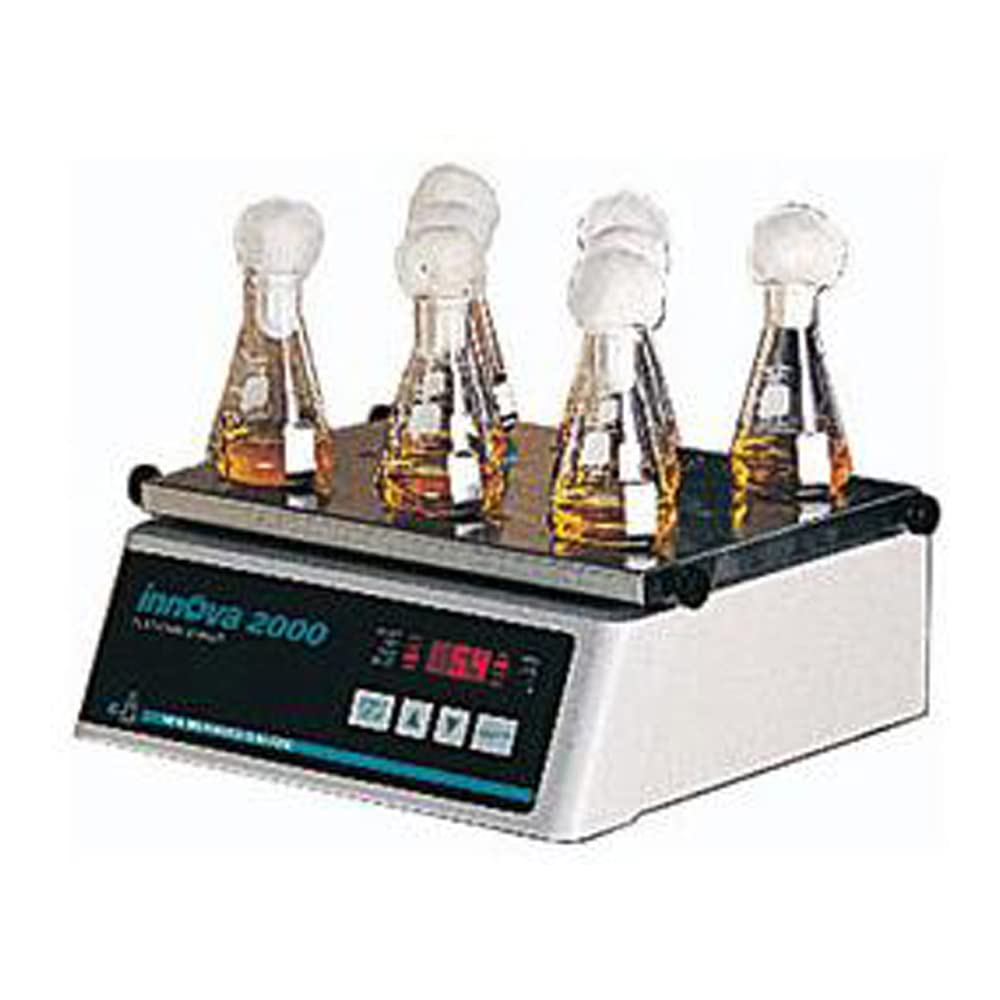

Eppendorf M1190-0012 Innova 2050 Single Fuse Orbital Shaker, 3 x 2L Capacity, 5.37" H x 14.5" L x 17" W, 220/230V, 50/60Hz
 5.0 (122 items)
 Limited Time Sale
$1,885.87 cheaper than the new price!!
Free cash-on-delivery fees for purchases over $99
Product details
| Management number | 210859575 | Release Date | 2026/04/04 | List Price | $1,257.25 | Model Number | 210859575 | ||
|---|---|---|---|---|---|---|---|---|---|
| Category | |||||||||
The Eppendorf M1190 series Innova 2050 benchtop digital orbital shaker operates at speeds between 25 to 500rpm, and has continuous or timed shaking, an orbital motion range of 1.9cm/0.75", and a large LED. This shaker fits a 16 x 12 inches (W x D) platform (sold separately) to hold up to 3 x 2L Erlenmeyer flasks. The unit has continuous shaking or timed shaking between 0.1 to 99.9 hours for ease of operation. The orbital motion provides uniform mixing with a smooth continuous circular action. The large three-digit LED shows speed, time, setpoints, and status for clear readings. Audible and visual alarms alert to setpoint deviation or end of study. Key parameters are stored in non-volatile memory in the event of a power interruption. Laboratory shakers are used in many analytic procedures, including drug analysis, water pollution analysis, and hemolysis.A temperature monitor module with a resistance temperature detectors (RTD) electronics-based measuring device (sold separately) can be installed to measure the ambient temperature or the temperature of the liquid in any vessel. With this module, the LED displays the measured temperatures in 0.1°C increments. The module also allows the connection of a chart recorder so that shaking speed and temperature can be documented. The output can also be connected to a data-logging computer with an analog data acquisition card (sold separately). This shaker has a triple-eccentric, counterbalanced drive with a broad-based, cast-iron support mechanism for high-speed applications and heavy workloads. The shaker comes with additional stabilizing feet and counterweight to balance larger loads on the oversized platform. The unit measures 5.37 x 17 x 14.5 inches (H x W x D) and weighs 35lb. (H is height, the vertical distance from the lowest to highest point; W is width, the horizontal distance from left to right; D is depth, the horizontal distance from front to back.) This shaker conforms to the Underwriters Laboratories (UL), Canadian Standards Association (CSA), and European Conformity (CE) marking standards. Laboratory shakers agitate liquids during laboratory procedures. These devices can be analog or digital and are typically an automated, electrically powered, countertop unit that shakes liquid in lab containers, such as flasks, funnels, or test tubes. Some shakers can operate inside fume hoods, incubators, refrigerators, or other laboratory devices, and can include controls for the frequency and/or degree of movement. The types of shakers include: orbital, rocking, rolling, rotating, and wrist action. The most common orbital shaker provides a smooth, continuous, circular motion, sometimes with a tilt angle, for uniform mixing of contents. The rocking shaker creates gentle uniform mixing with a see-saw, or up and down, motion. Reciprocating, or rolling, shakers provide a horizontal side-to-side motion with simple agitation of samples. A rotating, or rotisserie, shaker provides samples with a rotating action that moves in a circular motion. Wrist-action shakers duplicate the effect of hand mixing with "arms" on each side of the unit. Some shakers have the ability to incubate or refrigerate samples while providing shaking action.Eppendorf manufactures instruments for cell manipulation and automated devices for liquid handling, for use in life science research laboratories. The company, found in 1945, is headquartered in Hamburg, Germany.
- Benchtop digital orbital shaker operates at speeds between 25 to 500rpm for uniform mixing with a smooth continuous circular motion
- Continuous or timed shaking between 0.1 to 99.9 hours for ease of operation
- Orbital motion range of 1.9cm/0.75" to ensure even mixing
- Large LED shows speed, time, setpoints, and status for clear readings
- Fits a 16 x 12 inches (W x D) platform (sold separately) to hold up to 3 x 2L Erlenmeyer flasks
| Manufacturer | Eppendorf |
|---|---|
| Item model number | M1190-0012 |
Orbital Shakers



Correction of product information
If you notice any omissions or errors in the product information on this page, please use the correction request form below.
Correction Request Form